
Stop a battery fire becoming a building fire
Lithium-ion batteries fail rarely, but when they do they fail severely: the fire starts inside the cell, feeds itself, and is difficult to put out.
This site sets out what UK law actually requires when you hold batteries at work, what the incident figures show, and where storage and charging cabinets genuinely help. Written for the people who have to make the decision and sign it off.
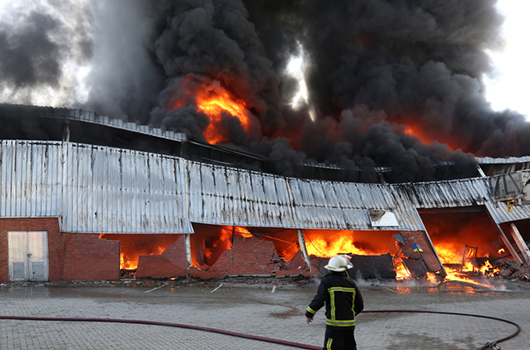
The scale of it in the UK
206
e-bike and e-scooter fires in London in 2025 — an average of 17 a month. Around 83% involved an e-bike (171 fires). Two people died.
Source: London Fire Brigade, 28 January 2026.
211
e-bike and e-scooter fires recorded across the UK in 2024, with 86 injuries and 8 deaths. London supplied 175 of those notifications.
Source: Office for Product Safety and Standards, via the Department for Business and Trade, 21 July 2025.
Those two figures are not directly comparable — one covers London in 2025, the other the whole UK in 2024 — and the second is built largely from London notifications, which tells you how patchy national reporting still is. Read together they show a risk concentrated in a few premises types, not a hazard spread evenly across every workplace.
Why it is not an ordinary fire
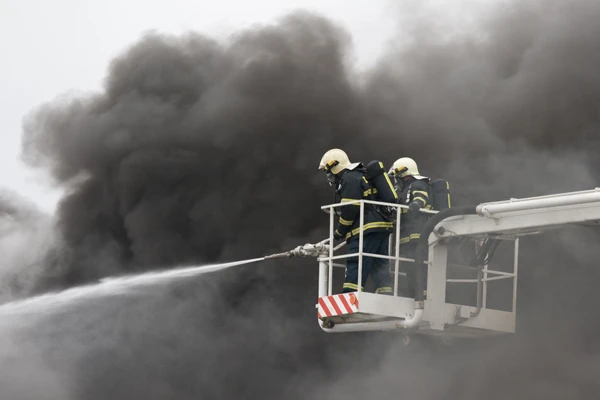
A cell in thermal runaway generates its own heat and releases its own oxidiser, so smothering it does not stop the reaction. It vents flammable and toxic gas before any flame is visible, it spreads to neighbouring cells, and it can reignite hours after appearing to be out.
Premises fire precautions designed around conventional fuel loads are not automatically adequate for this. That is the whole reason this site exists.
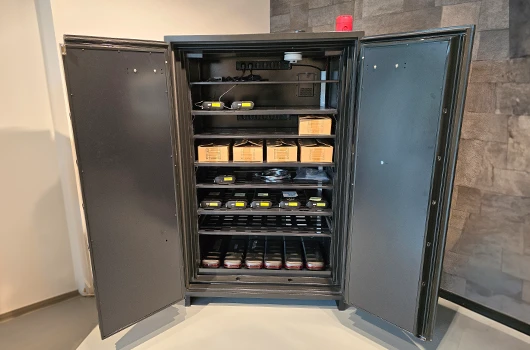
A cabinet is the last control, not the first
Ranked by effect per pound spent, the order runs: control what comes on site, move charging off escape routes, stop unattended overnight charging, separate damaged cells, store at partial charge — and only then contain what remains.
That is the reverse of how the market presents the problem. A cabinet is the easiest thing to buy and the last thing that helps. It is worth having — but a cabinet full of counterfeit chargers, sited in a corridor, has not addressed the risk.
Start here
Lithium battery fires
How a cell goes into thermal runaway, what off-gassing means for detection, and why a battery fire behaves differently from the fires most premises are equipped for.
Regulations
There is no single UK regulation covering lithium battery storage. What does apply is a set of general duties, and they bite harder than most people expect.
Storage and charging
State of charge, temperature, separation and supervision — the arrangements that make the largest difference for the least money.
Battery cabinets
What a cabinet does and does not do, what the tested ratings actually mean, and how to size one on watt-hours rather than on how many batteries fit.
Not sure what you need?
Four questions — what you store, how much of it, whether you charge in place, and which sector you are in — are usually enough to tell whether a standard cabinet covers your requirement or whether it needs specifying properly.
Nothing is collected and nothing is sent until you choose to. The result appears on the page.
Every figure sourcedNamed source and an outbound link on every statistic. No estimates presented as data.
Standards described as testedWe say what VDMA 24994 and EN 14470-1 actually cover, including where the industry disagrees.
Ownership stated openlyPublished by Marzan Security Ltd, which also sells cabinets. How this site is funded.
Frequently asked questions
Is a battery storage cabinet a legal requirement in the UK?
No. No UK regulation names a battery cabinet as a required control. What the law requires is that you assess the risk and put suitable measures in place; a cabinet is one control that may be part of that, alongside separation, charging arrangements, detection and procedures. The right question is not “is it required” but “what does my risk assessment justify”.
Can a battery fire be put out with a normal extinguisher?
A cell in thermal runaway generates its own heat and releases its own oxidiser, so smothering it does not stop the reaction the way it stops an ordinary fire. Large volumes of water can cool a pack enough to slow propagation, which is why fire services use them, but this is a containment and cooling problem rather than a straightforward extinguishing one. Plan on containing and evacuating, not on fighting it.
Who publishes this site?
Marzan Security Ltd (Company No. 12251272), which supplies and installs battery storage and charging cabinets. We state that on every page that recommends anything, and the guidance here is written to be useful whether or not you ever buy a cabinet from anyone. See About.